How Broken Links and Errors Impact User Experience
My career in IT began in 1996, when the internet was still in its early stages. By 1998, the same year Google was launched, I had already started exploring the potential of e-commerce and online marketing. During those early years, I had the opportunity to work with global organizations such as Bank of America and Hewlett-Packard in the USA and Japan, gaining valuable experience in large-scale digital systems and enterprise technology.
In 2005, I returned to India and founded SpiderWorks, which later grew into a trusted web development and digital marketing agency serving businesses in places like Dubai and beyond. Over the decades, watching the internet evolve has taught me one important lesson: true digital excellence lies in the smallest details.
Even the most visually impressive website can quickly lose credibility if it contains broken links or frequent 404 errors. These small technical issues send negative signals not only to users but also to search engines. In this article, I’ll explain why fixing such problems is critical and how addressing them can protect your website’s performance and prevent potential revenue loss.
Common Causes of Broken Links and Errors
Over the past 25+ years, I’ve realized that broken links are rarely caused by one major failure. More often, they creep in gradually for simple, avoidable reasons such as:
- Deleted Pages: Removing a product or service page without setting up a redirect.
- URL Restructuring: Changing a URL for SEO but forgetting to update old links.
- Typos: A simple misspelling in the URL string is enough to kill a link.
- External Changes: You lose control when you link to a third-party site; if they restructure, your link breaks.
How Broken Links Impact SEO and User Experience
If I could talk to every business owner, I would say this: Google follows the user. If the user gets frustrated, Google will eventually penalize you.
The Death of Link Equity
Think of links as pathways that pass authority across your website. When a link is broken, this flow is interrupted, preventing search engines from properly crawling your pages and reducing their ability to rank effectively.
Wasting the "Crawl Budget"
Google doesn't spend infinite time on your site. It assigns you a "crawl budget." If Googlebot spends its time hitting 404 errors, it might leave your site before it ever finds your brand-new, high-value content.
Escalating Bounce Rates
Imagine visiting a website, clicking on a link, and landing on a 404 page instead of the expected content. Most users leave immediately. This increases bounce rates and sends negative signals to search engines, indicating poor user experience and lowering your site’s ranking potential.
Loss of Professional Credibility
Errors signal poor maintenance. If a potential client sees that you can't keep your own website functioning, they may wonder if your professional services are equally neglected.
How to Find and Fix Broken Links?

This shows 216 pages affected by 404 errors - a common consequence of unmanaged broken links.
You cannot fix what you cannot see. For small sites, manual checking might work, but for growing businesses, automation is essential.
- Google Search Console: This is your first line of defense. Check the "Indexing" and then “Pages” to see which URLs Google tried to crawl but couldn't find.
- Audit Tools: We often use professional tools like Semrush to perform deep crawls that identify 404, 400 (issue with URL), 410s (permanently gone), and 502 (server) errors.
- The 301 Redirect: This is the best way to fix broken links. A 301 redirect informs the browser and the search engine that this page has moved permanently to a new location. It keeps your SEO power intact and directs the user properly.
How Regular Website Maintenance Prevents These Issues
The strongest digital platforms aren’t the ones that are constantly fixed; they’re the ones that are actively maintained. That perspective is central to our website maintenance services at SpiderWorks. A website isn’t something you build once and forget about. It’s a dynamic system that requires regular care to stay healthy and effective. Here’s how our structured process helps prevent broken links, performance issues, and technical wear over time:
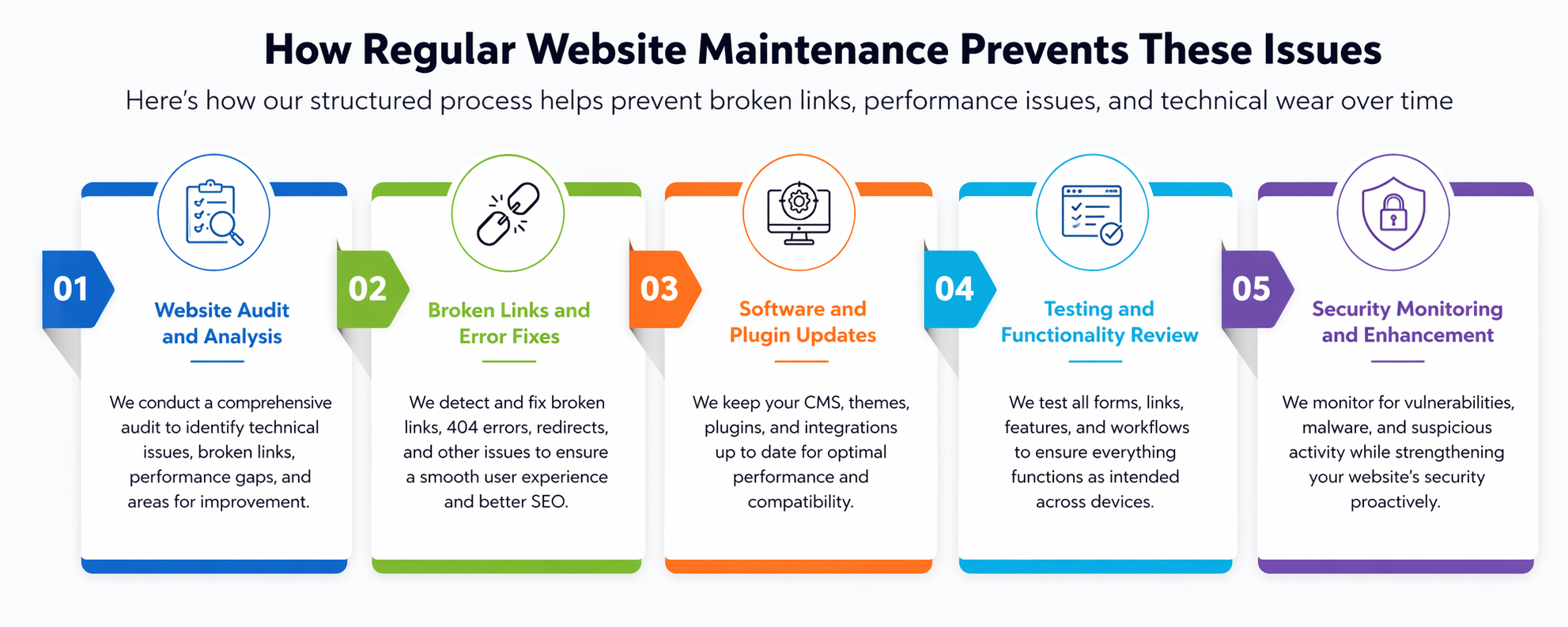
Website Audit and Analysis
We rely on data, not guesswork. Our process starts with a thorough review of your website’s performance, security, and overall functionality. This lets us find broken links, slow pages, and potential risks before they affect user experience or search rankings.
Broken Links and Error Fixes
Ongoing maintenance includes detailed scans of your site. We not only identify 404 errors but also fix them. Whether it's necessary to make modifications in WordPress or custom PHP coding for particular platforms, we ensure your website’s internal routes operate efficiently.
Software and Plugin Updates
Outdated systems often create technical issues. For platforms like WordPress, we ensure your CMS, themes, and plugins stay up to date, preventing compatibility problems and unexpected breakdowns.
Testing and Functionality Review
We go beyond links. We regularly test your forms, shopping carts, and login systems. A broken "Buy Now" button can be far more expensive than a broken blog link.
Security Monitoring and Enhancement
Technical errors aren’t always accidental. Security threats and server failures can also cause disruptions. That’s why we perform regular backups, monitor SSL, install firewalls, and run malware scans. If something goes wrong, we restore your site quickly and safely.
If you need custom website development in Dubai, SpiderWorks is your go-to for a seamless, high-performing interface between your brand and your client.
Read more on: What is a Good Website Load time in 2026: Speed Statistics Every Business Should Know.
Final Thoughts
In the digital world, your strength is only as good as your weakest link. Don’t let a few 404 errors hinder your growth. I’ve spent over two decades helping businesses shine by improving the technical details that others overlook.
Broken links and 404 pages aren’t just small technical hiccups. They represent lost chances to connect. Every broken link represents a moment where a visitor decides to leave, and each crawl error signals to search engines that your site might not be trustworthy enough for high rankings. Addressing these issues goes beyond simple housekeeping; it safeguards your link value, helps search engines use their crawl budget wisely, and shows respect for the people visiting your site.
When regular website audits and ongoing maintenance become part of your digital approach, you shift from fixing problems after they appear to preventing them altogether. The result is a website that works as a clear, dependable connection between your brand and your audience, not a source of friction. At SpiderWorks, we see a well-maintained website as one of the strongest marketing assets a business can have.
If you’re ready to eliminate hidden issues and strengthen your website’s performance, connect with SpiderWorks, your trusted SEO expert in Dubai, and take the first step towards a faster, cleaner, and more reliable online presence.