The GEO Checklist: Essential Steps to Optimise for AI Assistants
For years, I’ve worked side-by-side with businesses to help them get noticed through traditional SEO. Back then, the goal was pretty straightforward: rank higher on search engines, drive traffic to your site, and turn those visitors into customers. But lately, there’s a massive shift in how people actually search for information.
We’re moving away from the era of "browsing." Instead of scrolling through a long list of search results, people are now going straight to AI assistants with their questions and expecting an answer right then and there. They aren't clicking through ten different links; they’re relying on a quick summary. This means your website could be sitting at the very top of Google yet remain completely invisible if these AI systems aren't picking up your content.
That’s exactly why Generative Engine Optimization (GEO) has become so vital. It isn't about replacing SEO; it’s about going a step further and making sure your content is actually used by AI assistants.
What We’ll Cover in This Guide
This article dives into how content discovery is changing and what that means for your brand.
- GEO focuses on making your content usable by AI assistants, not just searchable
- Being "AI-visible" is quickly becoming just as important as your search engine rank.
- If your content isn't structured and clear, an AI can't summarize it.
- Authority, accuracy, and keeping your info fresh are the main reasons an AI will choose you over a competitor.
- SEO is still your foundation, but GEO is how you take your strategy to the next level.
What is GEO (Generative Engine Optimization)?
At its core, Generative Engine Optimization is about shaping your content so that AI assistants can actually find it, make sense of it, and most importantly, feel confident enough to use it as a source.
While traditional SEO is great for helping your website show up in a list of search results, GEO focuses on the next step: whether your content is actually selected to be part of the answer. A simple way to look at it is that SEO gets you noticed, but GEO gets you chosen.
From what I’ve seen, a lot of businesses are still stuck in a rankings-only mindset. But as AI assistants increasingly act as the middleman between brands and users, the real competition has shifted. It’s no longer just about whose website is at the top; it’s about whose information is actually being used to generate the response.
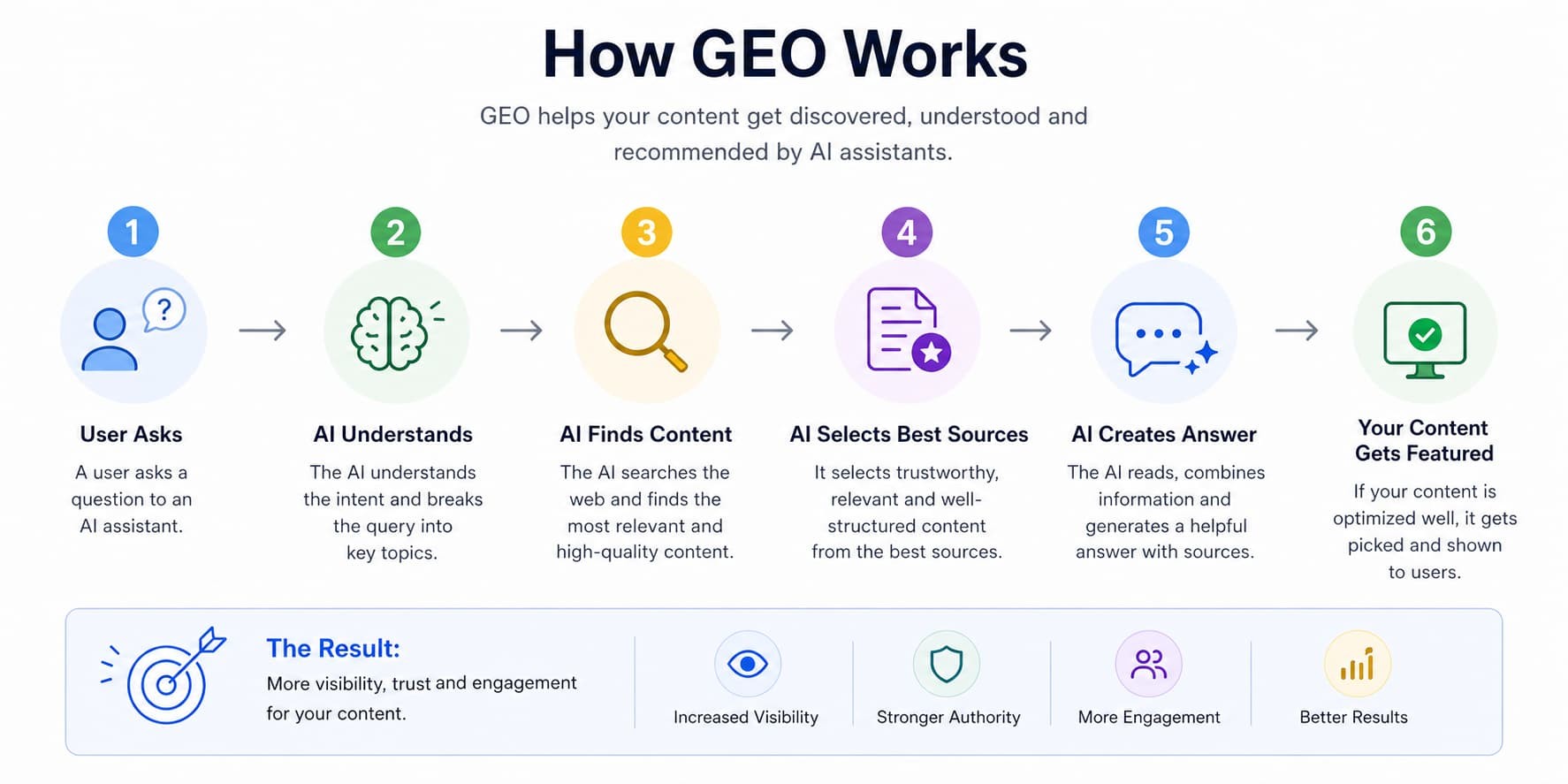
Importance of Being “AI-Visible” Rather Than Just “Search-Visible”
In the old days, visibility was easy to define: you just wanted to show up on page one. Today, real visibility is about being included in the AI’s summarized answer. When someone asks an AI assistant a question, they usually get one concise, summarized response. If your content isn’t a part of that specific summary, it doesn’t really matter how well you rank on a traditional search page; in that moment, you’re effectively invisible.
Being AI-visible means your content isn't a block of text. It needs to be structured so that a machine can interpret it quickly. It requires your information to be clear, trustworthy, and incredibly easy to extract. This is where even the strongest websites often struggle. They’ve spent years optimizing for search engine crawlers but haven't yet learned how to speak the language of AI systems.
Get in Touch with AI SEO Agency In Dubai Now!
Why Optimizing for AI Assistants Matters
AI assistants are no longer an add-on feature; they are becoming the primary way users interact with information online. This shift changes how content is evaluated. Instead of focusing heavily on keywords, AI systems prioritise clarity, structure, and usefulness. They are designed to identify content that directly answers a question without unnecessary complexity.
Another important change is the reduced role of clicks. Users are increasingly satisfied with the answer they receive from the AI itself, which means your content must be part of that answer if you want to stay relevant. From a business perspective, this is a major shift. Visibility is no longer just about traffic; it’s about being present in the decision-making moment.
The GEO Checklist: Essential Steps
Over time, I’ve refined a set of practical steps that help content perform better in an AI-driven environment. These are not theoretical ideas but things that actually work when implemented consistently.
-
Write For Real Questions
The first change I recommend is shifting your focus from keywords to questions. People interact with AI using natural language, so your content should reflect that. Structuring headings as questions makes it easier for AI to recognise and extract relevant answers.
-
Keep Content Well-Structured
AI systems scan content before processing it. If your page is filled with long, dense paragraphs, it becomes harder to interpret. Breaking content into clear sections with meaningful headings and shorter paragraphs makes a noticeable difference.
-
Provide Clear Answers
One mistake I often see is delaying the main answer. AI prefers content that gets to the point quickly. When you provide a clear answer at the beginning and then expand on it, you improve your chances of being selected.
-
Build Trust and Credibility
AI systems are designed to prioritise reliable information. Clear authorship, accurate details, and updated content all contribute to credibility. In my experience, even small improvements in trust signals can make a big difference.
-
Keep Content Updated
Content that was accurate a year ago may not be relevant today. AI systems tend to favour up-to-date information, so reviewing and refreshing your content regularly is essential.
-
Write Naturally
There’s a tendency to over-optimize content in a way that makes it sound robotic. That approach doesn’t work anymore. Writing in a clear, natural tone not only helps readers but also improves how AI systems interpret your content.
-
Combine GEO with SEO
This is not about choosing one over the other. SEO still plays a crucial role in discovery, but GEO ensures your content is usable within AI-generated responses. The two strategies work best when applied together.
Common Mistakes to Avoid in GEO
As businesses start adjusting to this shift, I’ve noticed a few common mistakes people make. The biggest one is thinking that GEO is going to replace SEO entirely; it won't. They’re partners, not rivals. On the other hand, some people try so hard to speak to the AI that they end up with content that sounds like it was written by a robot for a robot, which completely misses the point.
Another huge missed opportunity is ignoring the content structure. You could have the most brilliant insights in the world, but if they’re buried in a messy layout, the AI is just going to skip right over them. Also, if you publish content once and never update it, the relevance reduces over time. In an AI world, if your information isn't fresh, it isn't relevant. Getting ahead of these mistakes now is going to save you a lot of frustration down the road.
Future of GEO and AI Search
If I look at where things are going, it’s clear that AI assistants aren't just a phase; they’re becoming the primary way we'll all discover and judge information. We’re moving toward a world where AI doesn’t just find a link for you; it interprets, summarizes, and basically presents a verdict that influences what a person decides to buy or believe.
In that kind of environment, being clear and authoritative aren't just buzzwords; they’re your only way to stand out. The businesses that jump on this now aren't just gaining a temporary edge; they’re building the kind of long-term credibility that’s hard to shake.
The Bottom Line: Why GEO is Non-Negotiable
To put it simply: the transition from traditional search to AI discovery isn't something in the future; it’s already here. Relying on SEO alone is like trying to win a race with only half an engine.
GEO is what bridges that gap. It’s the difference between your website sitting on a list and your expertise actually being the answer someone relies on. If you want to stay competitive as the digital space keeps shifting, you really can't afford to look the other way.
If you’ve been 100% focused on SEO services up until now, this is your signal to rethink your approaches. Start looking at your content through the lens of an AI assistant. The sooner you make these changes, the better your chances of staying visible. Don't wait for the old rules to stop working entirely. Start optimizing for the AI era today and make sure your brand is right where it belongs.